BurtLaw's Law and Livable Cities
Public toilets.  Despite our gallant attemps to avoid it, the subject keeps peeping its head into public discourse. I refer, of course, to a subject dear to the funny bones of little kids, urination. Earlier this week (week of 07.22.2001), a St. Louis paper reported that an alderwoman, who urinated in a wastebasket during a council meeting rather than yield the floor, was charged with "public urination." Yesterday (07.24.2001) it was reported that the Seattle City Council, by a tissue-thin margin, has approved "five high-tech, self-cleaning public toilets, which will cost the city $638,000 a year" to maintain. Today (07.25.2001) it was reported that the L.A. Council voted to install 150 self-cleaning toilets around the city; it was also reported today that "San Francisco is considering police patrols, video cameras and a telephone hot line as part of its campaign to combat crime inside its [23 self-cleaning computerized] high- tech JCDecaux Co. public toilets" (different brand than the toilets Seattle is purchasing). Therefore and wherefore, we feature as our "website o' the week" a site that features inter alia a) results of a public restroom survey, b) a report about a school that teaches people how to steal belongings of people using public restrooms, and c) a primer for women on how to use men's urinals -- yes, folks, all this and more at Restrooms of the Future. As a public service, we also provide links to The Toilet Museum and The Sulabh International Museum of Toilets, the latter being the online museum of the actual museum of the same name in New Delhi, India. The online museum is the creation of Dr. Bindeshwar Pathak (depicted right),
 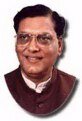 founder of the Sulabh Sanitation Movement, Editor-in-chief of The Sanitation Digest (a scholarly bi-monthly publication), and the man who "envisioned the need for the setting up of a museum of toilets in the sprawling campus of his central office at Mahavir Enclave, Palam Dabri Road in New Delhi, India." To those of you who think this is a funny subject, all I can do is a) tell you to wipe that smile off your silly spoiled American faces and b) quote Dr. Pathak, who put the matter most eloquently when he said, "Though the challenges to provide toilet facilities have been overcome in rich countries, [they have] still to be met in developing countries like India." I don't mean to contradict Dr. Pathak, but I don't believe "the challenges" have been met here in the richest countries, of which America is the prime example. If Dr. Pathak were in town visiting, I'd take him over to my favorite lake in Minnesota, Lake Calhoun, and show him the disgusting toilet facilities (several portable chemical toilets scattered along the 3.19 mile shoreline of the lake and small ill-kept, foul-smelling men's and women's indoor toilets in the refectory building on the northeast side of the lake) that the city government provides to the thousands of people who daily sit by or walk or run or jog or skate or pedal around the lake. If, as Jefferson said, "Eternal vigilance is the price of Liberty," I think it also is true that constant, obsessive-compulsive (yes, anal-retentive) dedication to the Sulabh Sanitation Movement is the price we men and women of Minnesota must pay if we want to bring "the Calhoun experience" out of the dark, smelly 19th Outhouse Century into the fresh, blue-skied 21st Public Sanitation Century. I suppose you think I'm kidding. I'm not. Indeed, if I were a resident of Minneapolis and were running for mayor or council in this year's elections, I'd run on a (toilet-seat-shaped?) platform advocating the city join the Sulabh Sanitation Movement. (07.25.2001) Update: Seattle's mayor rejects council's resolution that city spend $638,000 a year on five high-tech public toilets; he noted that Boston and San Francisco have high-tech public toilets paid for by advertising. [More] (08.07.2001)